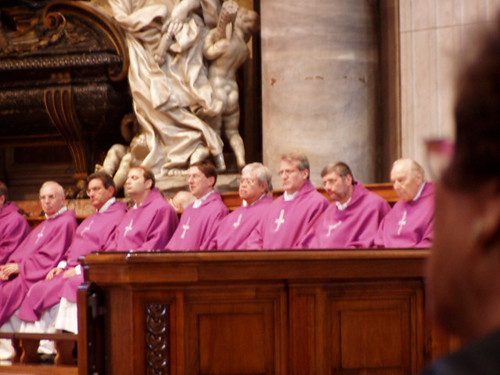
Last week, the church bulletin had a short blurb in it, tucked away on page three, which said that our parish priest was going to hold an adult education meeting on Wednesday evening to talk about the role of conscience in the daily life and touch upon his doctoral thesis work (his PhD was conferred just last month). Last night, there were fully 30 people who showed up to listen and to discuss the concepts regarding the primacy of conscience and how it relates to individual parishioners, specifically on the topic of sexuality and contraception. I'll not attempt in 50 words to recount what he outlines in a 300 page thesis, but the ensuing discussion brought out at least one point which wasn't central (or, perhaps, even mentioned) in the document - to wit, the changes in the laity and the affects on the clergy/laity relationship (and the Church/laity relationship).
For a great deal of the history of the Church, the vast majority of the laity had only the most rudimentary of formal educations. They were workers, farmers and tradesmen whose livelihood depended on what they could do, not what they knew. Ergo, the clergy existed as the bulwark of erudition in an otherwise featureless plain. In the last 150 years or so, however, the balance of intellectual power has significantly shifted in the nations of the first world (especially the US).
Particularly after the second World War, the pervasive spread of both secondary and post-secondary education has led to parishes overflowing with men
and women who are highly educated in both the arts and sciences. In our county specifically, over 50% of the adult population has at least a bachelor's degree. When a substantive portion of the laity has as much (or more) formal education as the episcopate, let alone the presbyterate, the pre-Vatican II 'Papa knows best' line, as recently echoed by our local arch-bishop "Catholics
must accept the Church's teachings", smacks as both offensive and condescending. The days of the Church, any Church, telling people how to think, believe and even vote are a relic of a bygone era (despite what our local prelate may propound) as the parishioners have the mental faculties and education needed to do that for ourselves.
Whenever our conscience condemns us, we will be reassured that God is greater than our conscience and knows everything. Dear friends, if our conscience doesn't condemn us, we can boldly look to God and receive from him anything we ask. We receive it because we obey his commandments and do what pleases him. This is his commandment: to believe in his Son, the one named Jesus Christ, and to love each other as he commanded us. Those who obey Christ's commandments live in God, and God lives in them. We know that he lives in us because he has given us the Spirit. (1 John 3:20-24)
I am not saying that those who have devoted their lives to the study and discussion of these things are not experts in their field or that their advice and counsel should be thrown away out of hand. Rather, that it is advice and counsel, rather than edict and commandment...thoughts of mortal and imperfect men about immortal and perfect things, not infallible pronouncements.
If the senior leadership is to teach, then they should recall that one learns as much from the students as they from the teacher....and we are all students of the Great Teacher.
 As noted in my previous post, I was asked the question Why?